You spent the night sick, and now your boss or school wants proof. Do you need a Doctor’s Note for Food Poisoning for a day or two away? It depends on your employer’s policy. Many workplaces ask for a note only after several missed days, but some ask on day one.
Most advice stops at symptoms and home remedies. This guide helps you decide when to see a doctor. Examples include a fever above 102°F, bloody stool, or diarrhea lasting more than three days. You’ll learn where to get a verifiable note, including online, and what it should say. It also covers return-to-work rules for food handlers and healthcare staff, plus safe home care while you recover.
Do You Need a Doctor’s Note for Food Poisoning?

Whether you need a Doctor’s Note for Food Poisoning depends on your employer or school. Many don’t ask for proof after a one- or two-day absence. A quick message to your manager is often enough.
Rules vary for several reasons. Attendance policies differ, and union or contract terms may set proof rules. Exams and deadlines often require paperwork. Repeated absences can also trigger a request, even for a short illness.
Main Considerations
Check your handbook, or ask HR or the school office, before you pay for a visit. The same rules usually cover a doctor’s note for stomach virus absence, so those policies are a good guide.
A note shows that a licensed clinician evaluated you and supports your absence. It doesn’t guarantee acceptance. Your employer or school makes that call.
Use this short checklist before you book a visit for a Doctor’s Note for Food Poisoning:
-
Missed more than two days? A note is more likely.
-
Does your policy name required proof? Follow it.
-
Is an exam, deadline, or contract term involved? Ask first.
-
Absent often lately? Expect a request.
-
None of these apply? A message to your manager may be enough.
When Do You Need a Doctor’s Note for Food Poisoning?
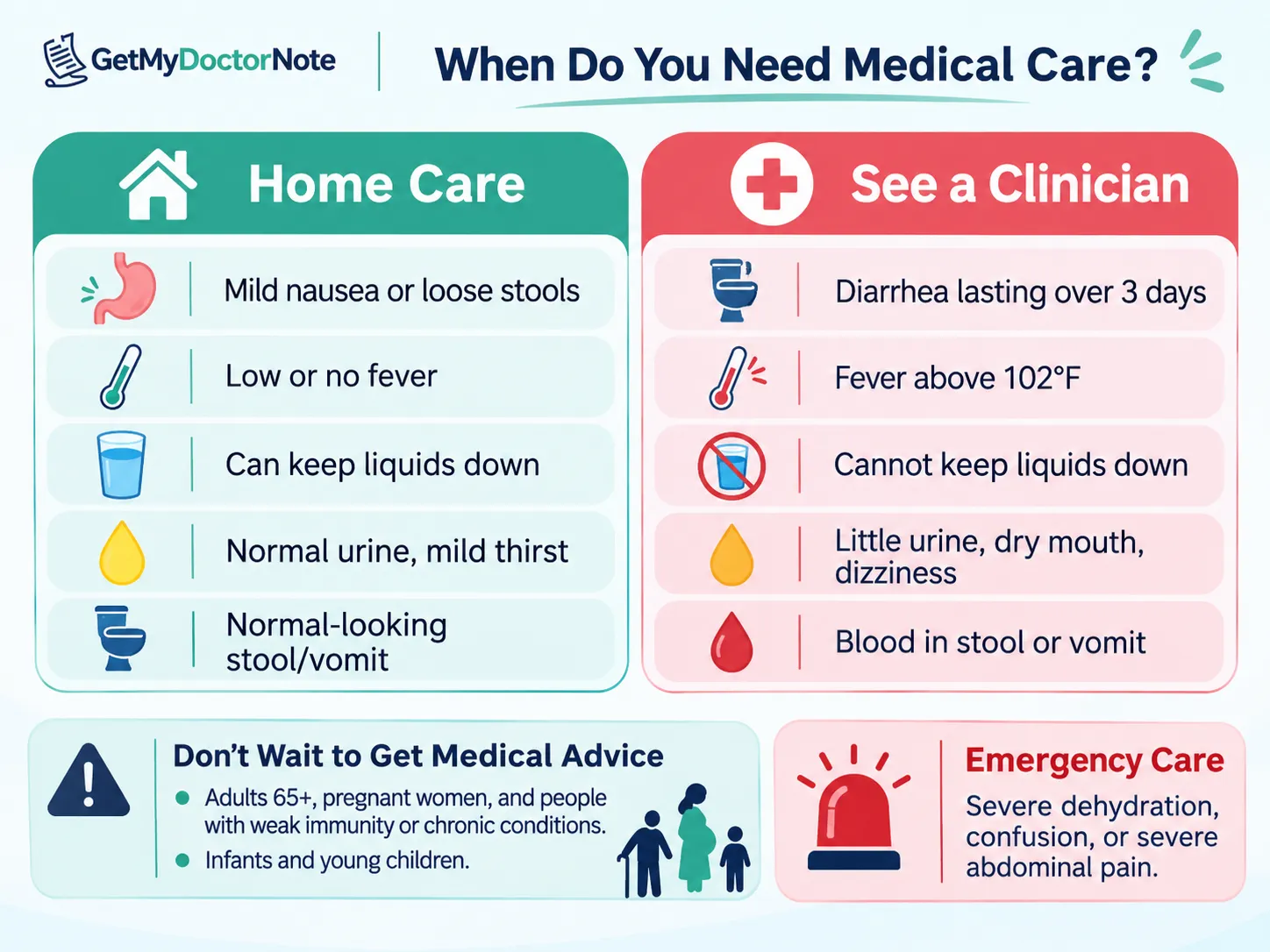
Mild cases often pass within a day or so with rest and fluids. In that case, you may not need a visit or a Doctor’s Note for Food Poisoning at all. Some signs, though, mean you should get care.
Red-flag Symptoms That Call for Medical Care
The CDC food poisoning signs and symptoms list the warning signs below. Symptoms that last beyond about three days deserve a call to a clinician. Dehydration is the usual danger, because fluid loss adds up fast.
| Home care is usually fine | See a clinician |
|---|---|
| Mild nausea or loose stools for a day or so | Diarrhea lasting more than 3 days |
| Low-grade fever or none | Fever above 102°F |
| You can keep small sips of liquid down | Frequent vomiting that stops you keeping liquids down |
| Normal urine and mild thirst | Little urine, dry mouth, or dizziness |
| Stool and vomit look normal | Blood in stool or vomit |
Who Should Not Wait It Out
Call a clinician early if you’re 65 or older, pregnant, or have a weakened immune system or a chronic condition. Infants and young children need prompt advice too. They can become dehydrated much faster than healthy adults.
Seek emergency care for severe dehydration, confusion, or severe abdominal pain. Get treated first. A Doctor’s Note for Food Poisoning can wait until you’re stable.
Once a clinician has seen you, you can ask for a Doctor’s Note for Food Poisoning. Getmydoctornote offers online visits with licensed clinicians if that’s the route you choose. Employers decide what they accept, so it helps to know whether an employer can reject a doctor’s note.
Where to Get a Doctor’s Note: Urgent Care, Telehealth, and Other Options
You have four main routes to a Doctor’s Note for Food Poisoning. They differ in speed, cost, and fit. The table shows estimates only, since prices vary by location and insurance. Check current prices before you book.
| Route | Typical wait | Typical cost (estimate) | Best for |
|---|---|---|---|
| Primary care | Same day to several days | $20 to $150 | Patients with an established doctor |
| Urgent care | 15 to 90 minutes | $100 to $200 | Same-day visits with fever or severe symptoms |
| Pharmacy clinic | 10 to 45 minutes | $60 to $150 | Mild symptoms, evenings, weekends |
| Telehealth | Often under an hour | $30 to $100 | Resting at home while sick |
Primary care works best if your doctor can see you quickly, since they already know your history. Urgent care suits a day when you have a fever and can’t wait for an appointment. A pharmacy clinic can help with mild symptoms, though services and hours differ by store.
Telehealth works from your couch. A licensed physician reviews your symptoms by video or form. If the clinician finds a note appropriate, they sign and issue one. For a Doctor’s Note for Food Poisoning, this saves a trip while you’re sick. Get information about how the online process works before you start.
Are Online Doctor’s Notes Accepted by Employers?
Many employers accept online notes when the note is legitimate. The clinician must hold a state license. The physician should sign the note, and your employer should be able to verify it by phone. Be careful with any service that promises a note no matter your condition. A clinician decides based on your symptoms, and your employer or school makes the final call on acceptance.
Getmydoctornote offers an online option with physician-signed notes. State-licensed physicians review each request, and employers can verify notes by phone 24/7. A Doctor’s Note for Food Poisoning from any source still depends on the clinician’s judgment.
What Should a Doctor’s Note for Food Poisoning Include?
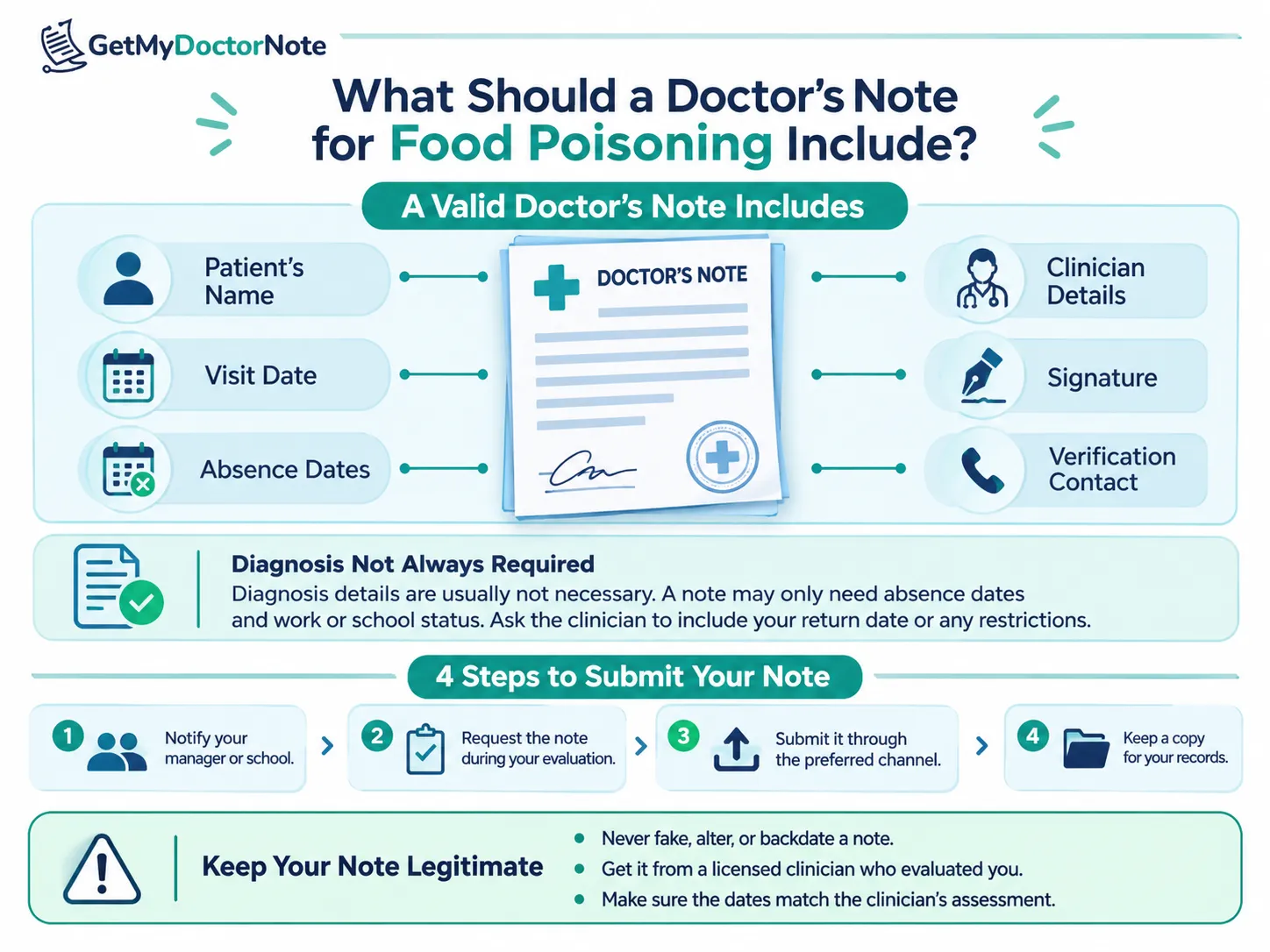
A valid Doctor’s Note for Food Poisoning gives a reader enough detail to check it. Look for these items:
-
Your name
-
Date of the visit
-
Dates you were or will be out
-
Clinician name and license details
-
Signature
-
A contact method for verification
A note usually doesn’t need to name your diagnosis. Readers can ask for dates and a work or school status only. Ask the clinician to add a return date or any restrictions during the same visit. Some employers also limit how long a note is valid, so ask early and follow these steps:
-
Tell your manager or school early.
-
Request the note when you are evaluated.
-
Send it through the channel they prefer.
-
Keep a copy for your records.
Other Considerations
Never fake, alter, or backdate a note. Employers and schools can call to verify it, and you risk discipline or dismissal. Get your Doctor’s Note for Food Poisoning only from a licensed clinician who evaluated you. The dates should match what the clinician can support.
Returning to Work After Food Poisoning: Requirements for Food Handlers and Healthcare Workers
Most general workers can return once symptoms ease and they feel able. Food handlers and healthcare staff follow stricter rules because they can spread germs to many people. A Doctor’s Note for Food Poisoning helps, but it may not be the only proof you need.
Which Illnesses Require Exclusion from Work and for How Long?
The FDA Food Code flags five illnesses for food employees. Rules vary by state and county, so check the FDA Food Code and your local health department. Don’t assume one universal rule.
| Illness | Who it affects most | What to confirm before returning |
|---|---|---|
| Norovirus | Anyone, especially people in group settings | Symptom-free period, often 48 hours |
| Salmonella (nontyphoidal) | Young children, older adults | Symptom-free period and employer rules |
| Salmonella Typhi (typhoidal) | Travelers, close contacts | Health department clearance |
| Shigella | Young children, group settings | Health department clearance or negative stool tests |
| STEC (Shiga toxin-producing E. coli) | Children, older adults | Health department clearance or negative stool tests |
| Hepatitis A | Unvaccinated adults and children | Health department clearance |
A common rule says food workers stay out until they’ve been symptom-free for 48 hours after vomiting or diarrhea stops. Some cases call for health department clearance or negative stool tests. A Doctor’s Note for Food Poisoning may not replace that clearance.
Healthcare workers should follow their facility’s infection-control policy and occupational health instructions. Those teams may set a return date even when you feel fine, so ask what paperwork they accept before you get a doctor’s note for work or school.
Ask the clinician to write a return-to-work date on your Doctor’s Note for Food Poisoning. A clear date saves your manager from guessing. It also shows you followed the rules for your job.
Home Care During Recovery While You Await Your Doctor’s Note

Start with fluids. Take small, frequent sips of water or an oral rehydration solution. Broth or electrolyte drinks can help if your stomach tolerates them. Small sips stay down better than big gulps.
Once vomiting settles, bring food back slowly. Try bland options such as toast, rice, bananas, or plain crackers. Skip alcohol, caffeine, and greasy or spicy meals for a while, since they can irritate your stomach.
Rest and paperwork can happen at the same time. You don’t have to wait for a Doctor’s Note for Food Poisoning before you start drinking fluids and resting.
Main Considerations
Ask a pharmacist or clinician before you take anti-diarrheal medicine. Do this even more if you have a fever or bloody stool, because those signs may need a clinician’s care.
Protect the people around you. Wash your hands with soap and water after using the toilet and before handling food. Don’t prepare food for others while you’re sick.
Keep a simple log. Write down when your symptoms started, each fever reading, and the fluids you drink. A sample entry might read “7 p.m., 100.8°F, 8 oz water.” A clinician can use this log to understand your illness. It also supports your request for a Doctor’s Note for Food Poisoning.
Conclusion
A Doctor’s Note for Food Poisoning isn’t always required. Many employers and schools accept a quick message after a day or two away, so read your policy before you pay for a visit.
Your health comes before paperwork. A fever above 102°F, blood in your stool or vomit, signs of dehydration, or diarrhea lasting past three days all call for a clinician. Choose the care option that fits your symptoms and your budget.
If your employer or school does want proof, check that the note lists your visit date, the dates you were away, the clinician’s license details, and a way to verify it. The diagnosis can usually stay off the page. Food handlers and healthcare staff should also ask for a return-to-work date, since their rules are stricter.
A note only helps when it’s real and verifiable. If you need one, start an online visit with a state-licensed physician through Getmydoctornote. You’ll get a physician-signed note you can send to your boss or school, so you can rest and recover without worrying about proof.
Start your online visit now and get your note today.