


A doctor’s note covers the dates a clinician writes on it, and nothing beyond them. So how long is a doctors note valid? It lasts for the absence period or the restrictions the note lists.
After that, you need a new note, and your employer or school decides whether the note fits their policy.
This guide explains what sets a note’s validity, what an online visit covers, what a note can and cannot say, and how to start. It is general education, not legal advice.
How Long is a Doctors Note Valid? When People Ask for One
People ask for a doctor’s note when an illness or injury keeps them from work or class.
Common cases include a short illness such as a cold or stomach bug, a contagious illness like strep throat, recovery after an injury, and any absence long enough that a handbook asks for proof.
In each case, the note records a clinician’s judgment about specific dates. A note that says you were unable to work from Monday through Wednesday covers Monday through Wednesday. It does not cover Thursday, and it does not cover a new illness next month.
That is the short answer to how long is a doctors note valid: it lasts as long as the dates and limits written on it.
Some workplaces ask for a note after a set number of missed days, and others ask for one every time. That broad rule has a limit under the FMLA, though.
One federal court ruled that requiring a doctor’s note for each intermittent FMLA absence violates the law, because the FMLA certification process governs those requests. Schools often follow a similar rule through the attendance office. Policies differ, so the same note can satisfy one employer and fall short for another.
For a walkthrough of what most employers expect, read our guide on how to get a doctor’s note for work.
What the Visit Covers
The visit is a real consultation with a licensed clinician. You do not fill out a form and download a document.
You describe your symptoms, when they started, and how they affect your ability to work or attend class. The clinician asks follow-up questions, then decides what care and documentation fit your situation.
Many visits happen the same day. Same-day does not mean instant approval. The clinician makes the call, and if your visit does not support a note, you will not receive one.
The how it works page lays out each step in order.
Have these details ready before you start:
-
Your symptoms and the date they began.
-
The dates you missed or expect to miss.
-
Any work or school guidance you need, such as rest days or limited duties.
-
The name of the employer or school that will receive the note.
What the Note Can and Cannot Say
What a Note Usually Includes
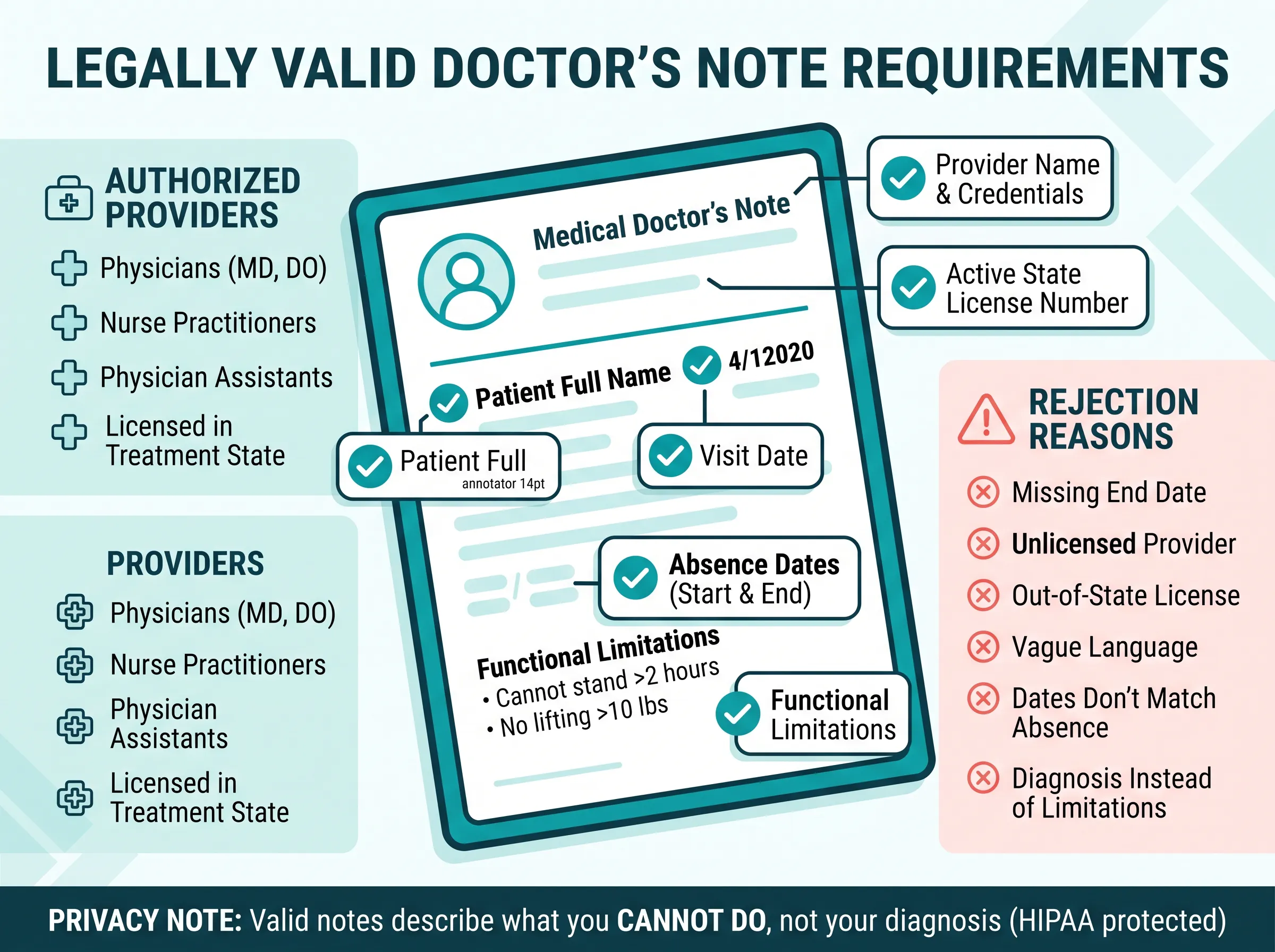
A note typically lists the clinician’s name and credentials, your name, the date of the visit, and the dates of absence or restriction. It also gives the work or school guidance the clinician supports, such as rest at home or a return date. It does not need to include a diagnosis.
A clinician adds diagnosis details only when they are needed, so you share less private health information with the people who receive it.
What a Note Cannot Do
A note cannot cover dates the clinician did not support. It cannot make an employer or school accept it. It is not a blank or pre-filled template, and you should not change the dates yourself.
An edited note can be rejected, and it defeats the purpose of having a clinician document your absence. If you need more time, you need a new visit.
When You Need a New Note
You need a new note when any of these happen:
-
Your illness or injury lasts past the end date on the note.
-
You get sick again after returning.
-
Your work or school restrictions change.
-
Your employer or school asks for a more recent note under its own policy.
Keep a copy of every note you receive. If a question comes up later, you can show which dates each note covered.
Examples of How Dates Work in Practice
Three short examples show how the dates on a note decide what it covers.
-
A short illness: A note covers Tuesday through Thursday for a stomach bug. If you are still sick on Friday, the note does not reach that day. You would need a new visit for Friday.
-
An injury with limits: A note says you should avoid lifting for one week. When the week ends, the limit ends too. If you still need the limit, the clinician must write a new one.
-
A school absence: A parent gets a note for two missed school days. The attendance office reads it as covering those two days only. A later absence needs its own note if the school asks for one.
In each case, the answer to how long is a doctors note valid comes straight from the dates on the page. Check them before you send the note anywhere. A date that is off by a day can cause an employer or school to question the whole note.

Why Dates Matter More Than the Note’s Age
A note does not expire because a certain number of weeks have passed. It simply stops covering new days once its end date arrives.
Some employers still want a recent note, and some schools only accept notes sent within a few days of the absence. Those are policy rules set by the employer or school.
They are separate from the dates the clinician wrote. If you are unsure which rule applies to you, ask HR or the attendance office before you submit anything.
Your Employer or School Still Decides
A valid note is still a request. Your employer or school sets the rules for what it accepts, how fast you must turn it in, and who receives it. A workplace may want the note within a few days of your return.
A school attendance office may have its own forms, deadlines, or limits on excused absences. Neither the clinician nor this site can promise that your note will be accepted.
Take these steps to reduce surprises:
-
Read your employee handbook or school attendance policy.
-
Ask who receives notes and how, such as email, a portal, or the front office.
-
Submit the note before any stated deadline.
-
Check that the dates on the note match the days you missed.
-
If the note is rejected, ask what they need and why, then decide on your next step.
Our guides for work and school cover common situations in more detail.
How to Check Your Note Before You Send It
A quick review can prevent a rejected note. Look at these points before you submit it:
-
The clinician’s name and credentials appear on the note.
-
Your name and the date of the visit are correct.
-
The start and end dates match the days you were out.
-
Any work or school guidance, such as a return date or a limit on tasks, is clear.
-
The file opens and prints cleanly, so the receiver can read every line.
If something looks wrong, contact the clinician’s office through the same service you used. Do not edit the note on your own. A fix from the clinician keeps the record honest and protects you if the employer or school asks questions later.
Questions to Ask Your Employer or School
Short, direct questions save time. Try asking:
-
How soon after an absence do you need the note?
-
Do you accept a note sent by email or through a portal?
-
Does a note for one absence cover a related absence a few days later?
-
Who should I contact if the note needs a correction?
The answers tell you how the rules apply to your case. They also help you decide when you need a new note rather than relying on an old one.
How to Start
Starting takes a few minutes. Follow these steps:
-
Check your policy and write down the dates you need covered.
-
Select the button below to open the welcome page.
-
Answer the questions and speak with a licensed clinician.
-
Review your note, check the dates, and send it to your employer or school.
Start your doctor’s note visit
A visit does not guarantee a note, and your employer or school makes the final call on acceptance.